
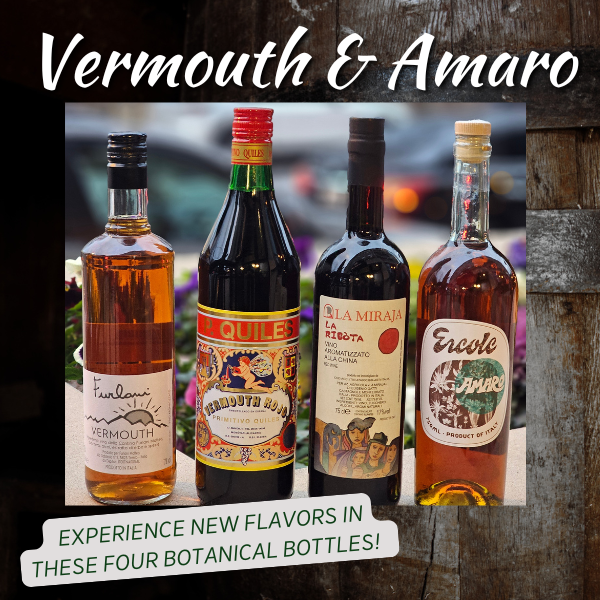
Amaro: An Italian herbal liqueur made by steeping botanicals in alcohol, then sweetening and aging the mix. Great to sip after a meal!
Vermouth: A wine that has been fortified with a neutral spirit and enhanced with botanicals. Commonly enjoyed before eating.
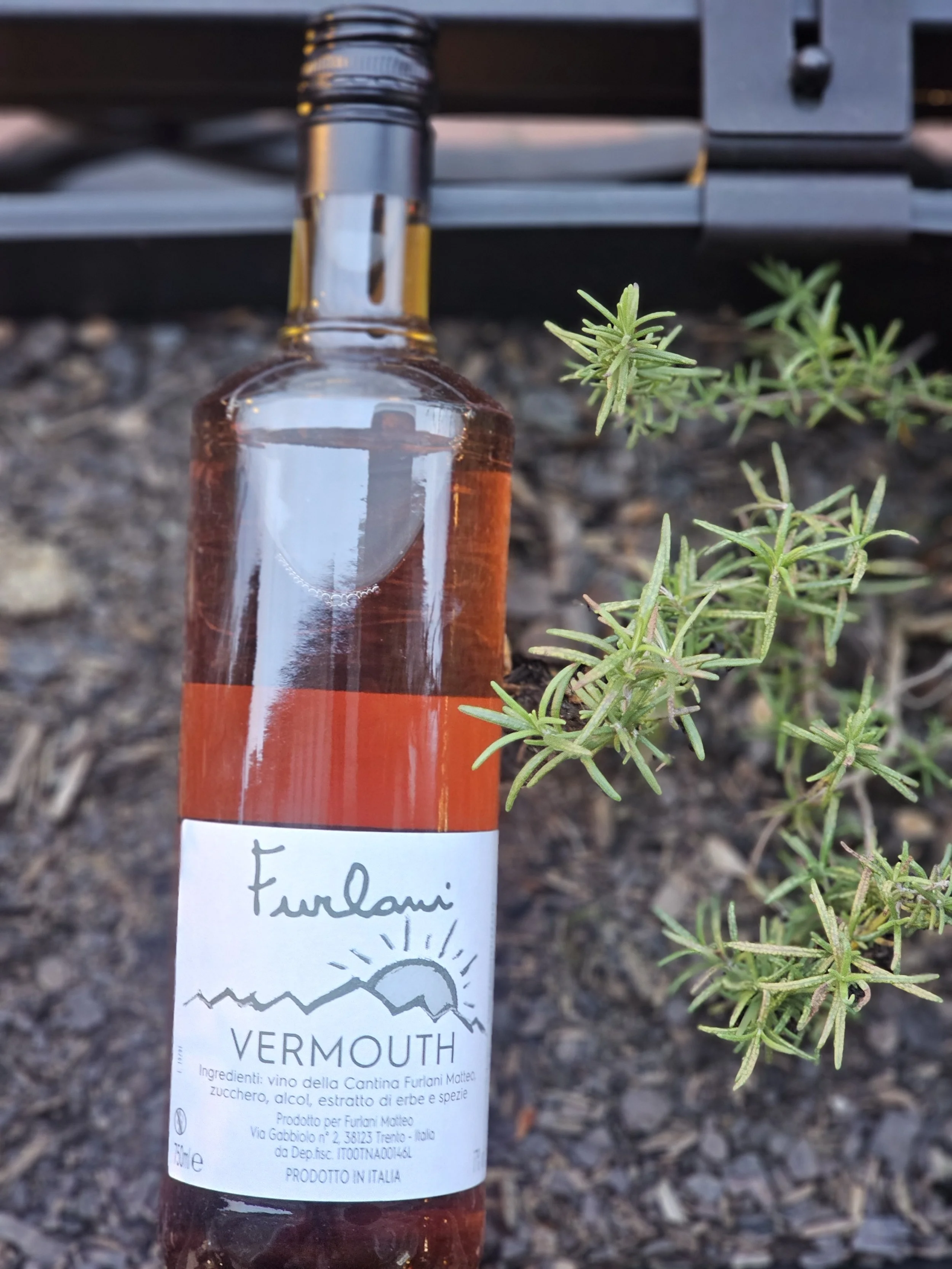
Furlani Vermouth
Grapes: Muller-Thurgau, Nosiola, Verdelet, Lagarino Bianco
Place: Trentino-Alto Adige, Italy
Process: Base wine is made using native yeast fermentation in a combination of cement tanks and small, glass demijohns. This wine is fortified to about 16% - 17% with a neutral spirit to stabilize the wine and help extract aromatics from the botanicals. After the botanicals are gently steeped in the fortified wine, a small amount of sugar is added to balance the bitterness. No fining or filtering. No sulfites added before bottling.
The botanicals are foraged locally in areas immediately surrounding the vineyard. They include sweet and bitter orange, chamomile, rhubarb, mint, and other various roots and spices.
Family: Towering over the alpine city of Trento, at some 700+ meters of altitude, are the tiny parcels of vines tended by Matteo Furlani. Matteo is the current custodian of his family plots high in the Dolomites; he is a fourth-generation winemaker.
After studying agronomy, not winemaking (he learned that from his father and grandfather) Matteo set his sights on working his land in the most natural of ways. Chemicals were never a part of what Matteo's predecessors used to tend the vines, yet Matteo took an even more rigorous approach, incorporating biodynamic preparations and methodologies in the vineyards today.
Bottle: $39 | Glass: $17
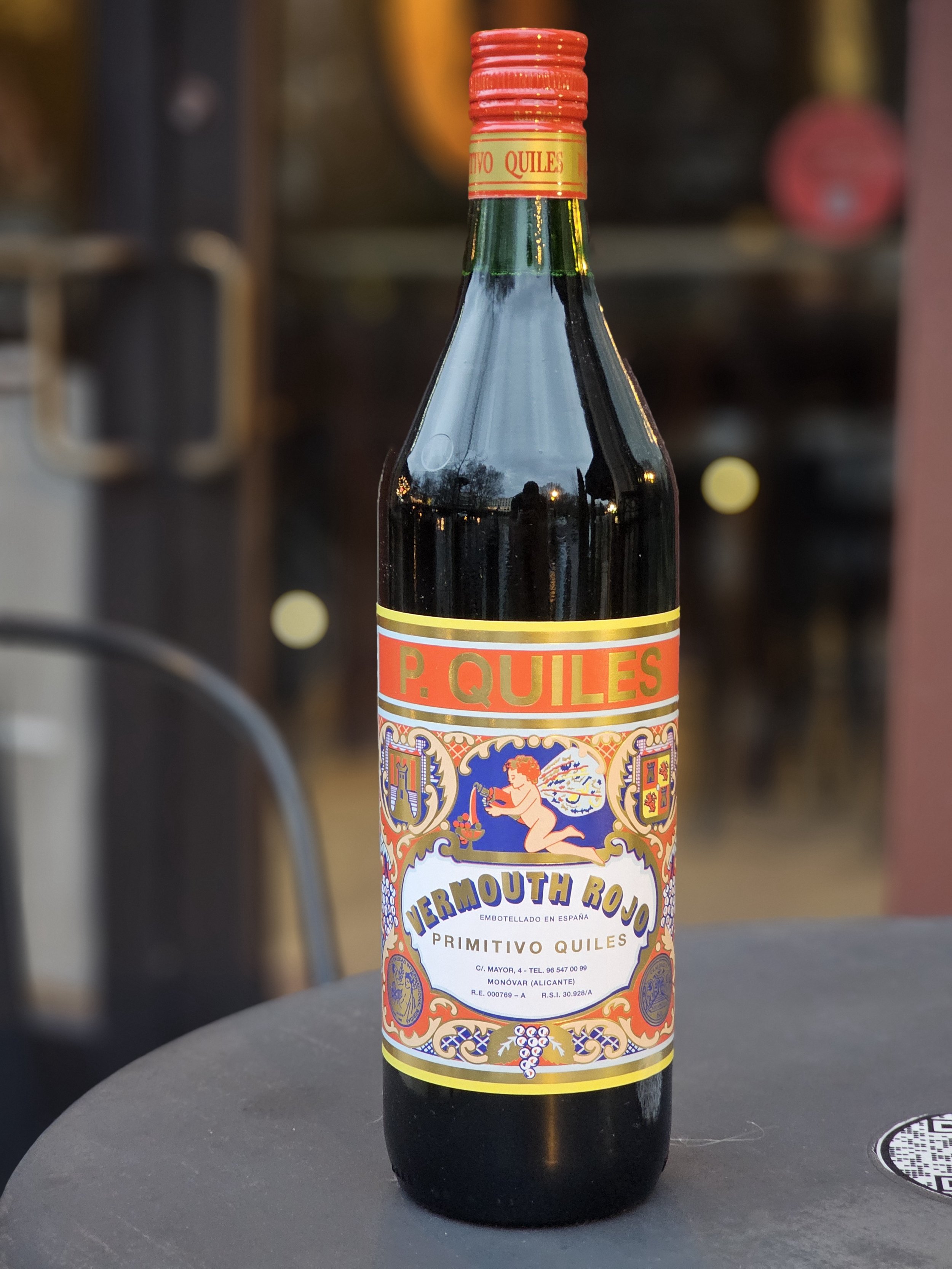
Primitivo Quiles ‘Vermouth Rojo‘
Grapes: Muscatel (Muscat)
Place: Alicante, Valencia, Spain
Process: Base wine is fermented until an ABV of 3%. ~150g/L of residual sugar left in the wine in order to balance the bitterness of the botanicals that are to be added. The wine is then fortified with a neutral spirit, bringing the ABV to ~15%. The vermouth is colored and further sweetened using Arrope (caramelized grape must), granting a deep reddish hue and a raisin/nutty component.
The botanicals used for maceration after the wine ferments include wormwood, cloves, ginger, cardamom, fennel, and sage.
Family: The Quiles family ties with wine date back to 1780 when it started in growing and winemaking in the lands of west the present province of Alicante. It was in the early twentieth century when Don Primitivo Quiles Verdú, degree in Enology, with various interest such as painting or photography, founded the current winery in Pinoso (Alicante), moving to the current location of Monóvar (Alicante) in 1926 to facilitate the transport of wine by rail to the port of the capital for subsequent export.
In the 30s and after his studies in France, Don Primitivo Quiles joined. In those years the trade to north of the peninsula were extended and exports increased mainly to Europe and North America.
In 1951 Don Primitivo Quiles Pérez joined the winery, renewing and adapting it to the new demands of the market, projecting it up to this days, since the beginning he turned to be the maximum promoter of Alicante wine, furthermore, he was working for the Spanish wine industry as Vice President of the National Federation of Domestic Wine Trade.
Currently his children Primitivo and Francisco are directing the winery.
Bottle: $35 | Glass: $15
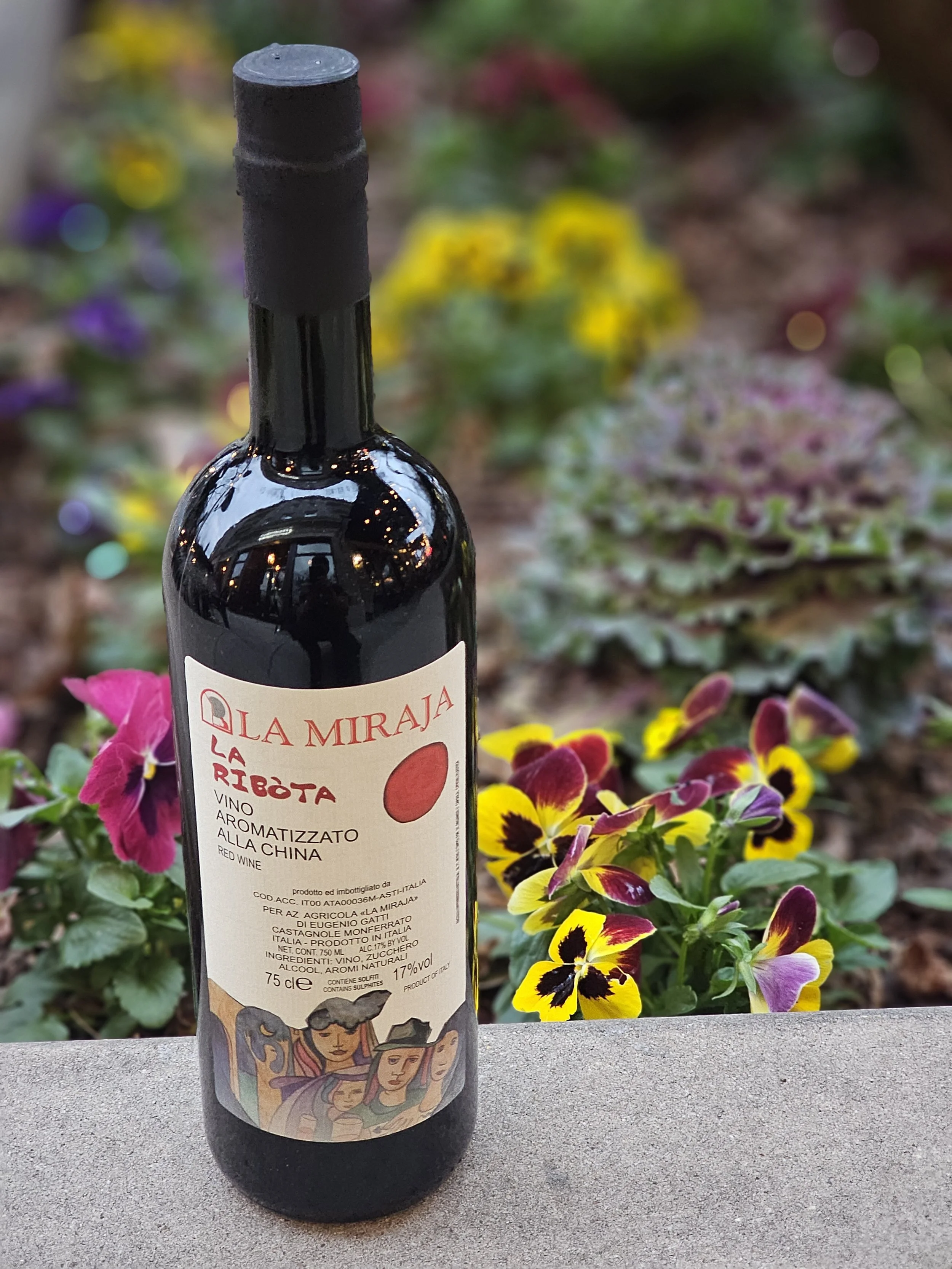
La Miraja
‘
La Ribòta’
Grapes: 100% Ruché
Place: Monferrato, Piedmont, Italy
Process: The base wine is made from estate grown fruit situated about 250 meters above sea level. The botanicals, herbs, and spices are macerated seperately from the base wine, instead being extracted into the neutral grain spirit that is later combined with the wine.
The spirit is infused with a combination of orange peels, cinnamon, cardamom seeds, china (pronounced “kee-nah“), and some additional secret family botanicals.
Once the Ruché wine is fortified with the infused spirit, the product is left to rest for 30 days before being racked into stainless steel to rest for an additional 3 months. Lastly, the fortified wine is bottled and rests for 3 more months minimum before it is released.
Family: Nestled within the original castle of Castagnole Monferrato, La Miraja was constructed as an armory in the 11th century, only to be retrofitted as a cellar in the 1400s. In this armory-turned-cellar, Eugenio Gatti, a seventh-generation viticulturist, turns out Barbera, Grignolino, Freisa, and his fabled Ruché. His oldest Ruché plantings are located in the famed Majole vineyard, one of the first sites in Castagnole Monferrato where the grape was planted with the intention of producing single-varietal wines. Majole was replanted in the 1970s, and its Ruché vines rank among the oldest in the world. This has long been considered the top site of Castagnole Monferrato—the epicenter of Ruché production and the first of seven villages granted permission to produce single-varietal Ruché under the DOCG. La Miraja (pronounced “me-rye-uh”) is tiny by any measure, comprising less than 4 hectares under vine. It is here that Eugenio devotes his life’s work to producing roughly 2,500 transcendent cases of wine each year. Harnessing his years of working in wineries and distilleries across Italy, he imbues his wines with a haunting purity and a simple elegance.
Bottle: $57 | Glass: $25
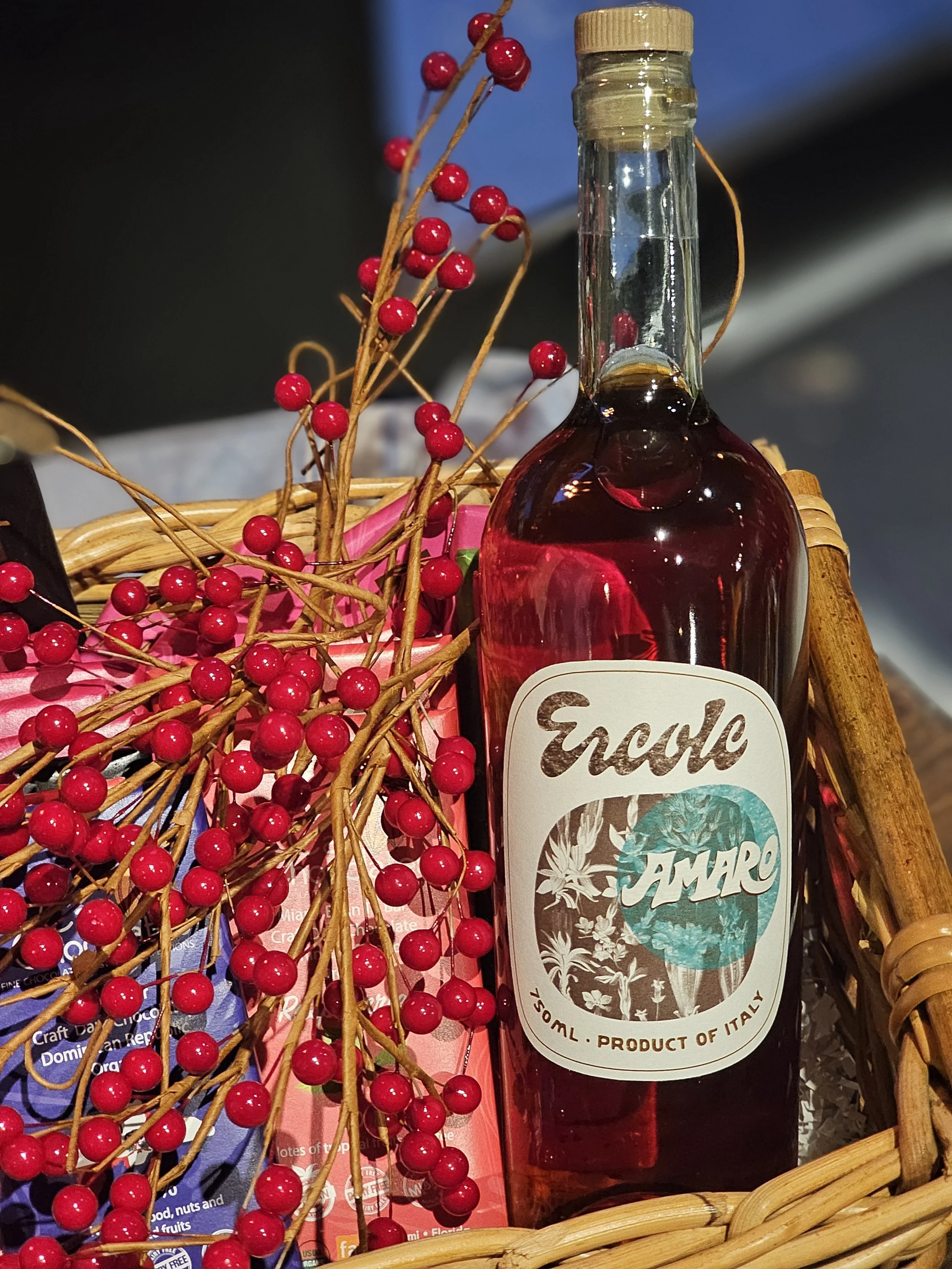
Ercole Amaro
Grapes: 100% Cortese
Place: Monferrato, Piedmont, Italy
Process: A base wine is made from local wine varietals. Each botanical used is soaked individually in its own water/alcohol tincture. Depending on the botanical, the tincture will have varying ABV levels due to certain plants and herbs needing higher alcohol concentrations for adequate extraction.
Gentian, rhubarb, quinine, cardamom, and citrus peels are of the most prominent botanicals used in the Ercole. The maceration process for these lasts anywhere between 20-30 days.
Once each botanical has soaked, the tinctures are then added to the base wine, and the mixture is held at a very cold temperature for 15 days. This stabilizes the wine and helps further integrate the botanicals into the final product. The amaro gets bottled with no further aging.
Family: Ercole, whose English translation is Hercules, is only made possible by a generations-old cooperative of local growers in the Monferrato area. Every fall, these men and women cultivate pristine and sustainably farmed fruit, allowing us to make authentic wines that are transmitters of time and place. Small, independent cooperative wineries like this are not only the lifeblood of thousands of small growers across Italy but also repositories safeguarding the native grape varieties and winemaking traditions of their respective regions.
The cooperative behind Ercole works predominantly with old vines ranging from 30 to 50 years old. All participating growers adhere to the European Union rule for sustainable farming known as lotta integrata, or lutte raisonnée, though many are now certified organic. None of these growers use systemic treatments or chemicals, employing only minimal copper and sulfur. Both vinification and bottling are certified vegan.
Bottle: $31 | Glass: $14